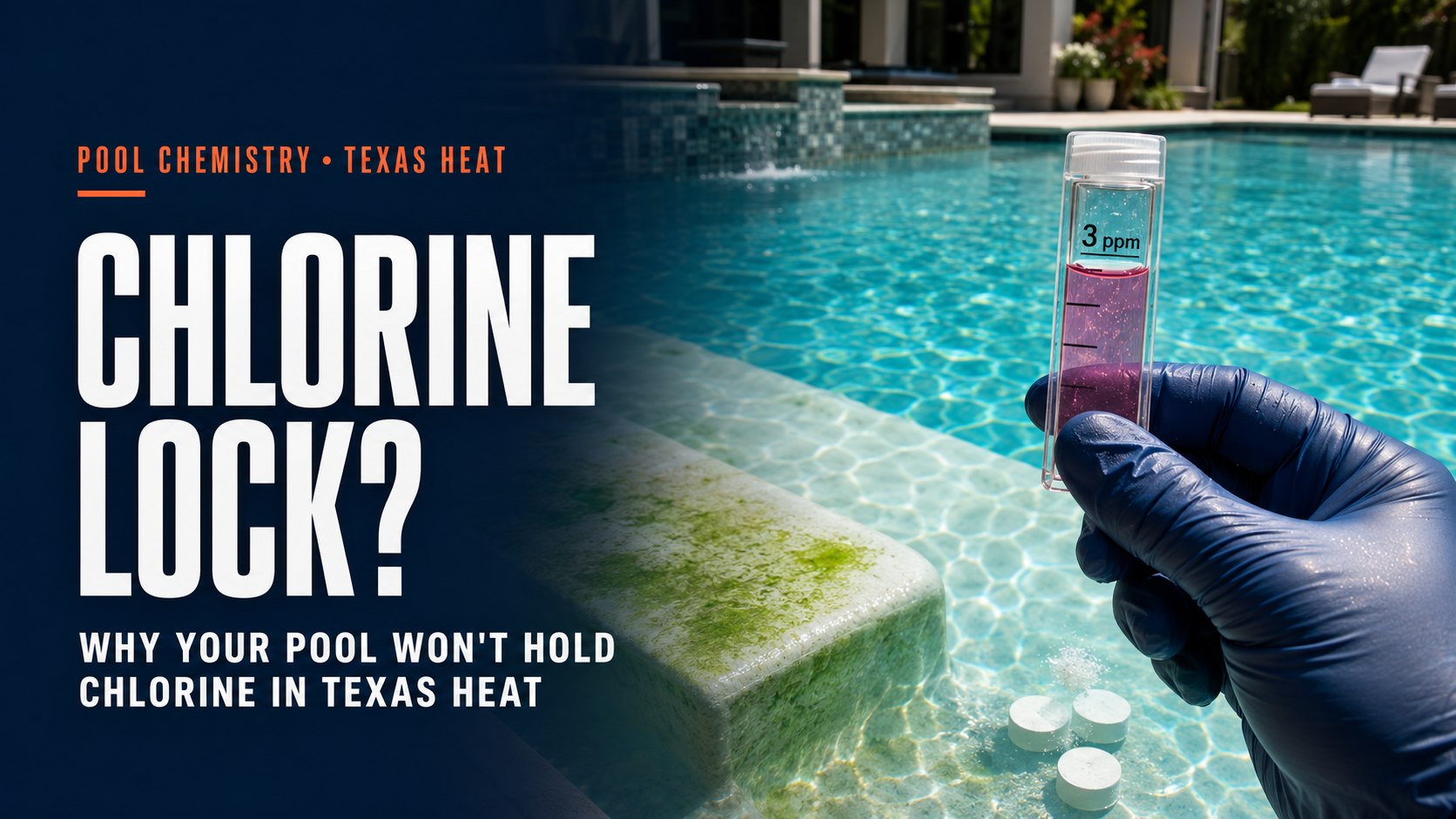
It's August in Houston. The floater is full of tablets. Your test kit reads 3 ppm chlorine — right where it's supposed to be. And there's a green film creeping up the steps that brushes off and comes back in two days.
You take a water sample to the pool store. They run it, look up, and say the words: "You've got chlorine lock." Then they sell you a bottle of something.
Here's the part they leave out: "chlorine lock" is not a real chemical state. There is no reaction in your pool that traps chlorine and holds it hostage. The term is shorthand — usually for one of three completely different problems, each with a different fix. Two of them the bottle won't touch.
The short version
Your chlorine isn't locked. It's either outnumbered (too much stabilizer), already spent (combined chloramines), or chemically weak (pH too high). Same symptom. Three different causes. Testing tells you which in about ten minutes.
What Pool Stores Mean vs. What's Actually Happening
Cyanuric acid — CYA, stabilizer, conditioner — bonds loosely with chlorine to shield it from UV. Without it, a Texas pool loses most of its free chlorine in a single afternoon. That bond is the whole point, and it's reversible: as chlorine gets consumed, the reservoir releases more. Nothing is permanently locked.
The real problem is one of proportion. Only a tiny fraction of your free chlorine is unbound at any moment, and that unbound fraction — hypochlorous acid — is what actually kills algae. The more CYA in the water, the smaller that fraction gets. At 40 ppm CYA, 3 ppm of free chlorine is plenty. At 120 ppm CYA, that same 3 ppm reading behaves like almost nothing.
Your test kit can't see the difference. It reports 3 ppm either way. That gap — between what the number says and what the water can do — is what people are describing when they say "chlorine lock."
Technician Tip
A free chlorine reading is meaningless without the CYA reading next to it. If a pool store hands you a printout with chlorine on it and no CYA number, you don't have a water test — you have half of one.
Cause #1: Your CYA Climbed All Summer (The Usual Suspect)
In Greater Houston, this is the cause roughly four times out of five. And it's almost always self-inflicted by the most convenient product on the shelf: 3-inch chlorine tablets.
Trichlor tablets are about 54% stabilizer by weight. Every tablet that dissolves delivers chlorine and permanently adds CYA — roughly 6 ppm of CYA for every 10 ppm of chlorine it releases. Chlorine gets consumed and leaves. CYA never does. It doesn't evaporate, doesn't burn off in sunlight, and doesn't filter out.
A tab-fed Houston pool through peak season adds somewhere in the range of 20–30 ppm of CYA per month. Start the season at a healthy 40 ppm in April, chlorinate exclusively with tablets, and by early August you're sitting between 120 and 160 ppm. Nobody did anything wrong. The floater just kept working.
Minimum Free Chlorine by CYA Level
The working rule among pool chemists: hold free chlorine at roughly 7.5% of your CYA level just to prevent algae.
| CYA Level | Min. Free Chlorine | Reality in August |
|---|---|---|
| 30–50 ppm | 2–4 ppm | Easy to hold |
| 60–80 ppm | 5–6 ppm | Workable, needs attention |
| 100 ppm | 7–8 ppm | Hard to sustain in heat |
| 140+ ppm | 10+ ppm | Practically unreachable — dilute |
For reference: the CDC's Model Aquatic Health Code caps CYA at 100 ppm for public pools, precisely because sanitizer performance degrades past that point.
Read that bottom row carefully. At 140 ppm CYA you'd need to hold 10+ ppm free chlorine continuously, in 100°F water, against Houston UV — which means dosing liquid chlorine daily and never missing. That's not a maintenance plan. That's a second job. Dilution is the answer, and it's the only one.
Cause #2: Combined Chloramines
The second thing called "chlorine lock" is chlorine that has already done its work and has nothing left to give. When free chlorine reacts with sweat, sunscreen, urine, and organic debris, it converts to combined chlorine — chloramines. Spent, inert, and still counted by any test that reports total chlorine.
This is the classic pool-store misdiagnosis. Their strip reads 4 ppm total. Yours might be 1 ppm free and 3 ppm combined. The water looks dull, smells aggressively of "chlorine," and stings eyes — all symptoms of chloramines, not of too much sanitizer.
The test: measure free chlorine and total chlorine separately. Subtract. Anything above 0.5 ppm of combined chlorine needs breakpoint shock — a dose large enough to oxidize the chloramines completely. A partial dose makes it worse. This is one of the few times "shock it hard" is the correct advice.
Technician Tip
That sharp chemical smell at a public pool isn't chlorine — it's chloramines. A properly sanitized pool smells like almost nothing. If your backyard smells like a hotel pool, you have a chloramine problem, not a chlorine surplus.
Cause #3: pH Drift Above 7.8
The quietest of the three, and the fastest to fix. Chlorine's killing power depends on how much of it exists as hypochlorous acid, and that ratio is governed by pH.
At pH 7.2, roughly 63% of your free chlorine is in the active form. At 7.5, about 50%. At 8.0, it collapses to around 24%. Same chlorine reading, less than half the sanitizing power.
Two things push Houston pools alkaline in August: aggressive aeration from water features and returns, and the sheer volume of evaporation and refill in 100°F weather. Salt pools drift up faster still — chlorine generation itself raises pH. A salt pool that hasn't had acid added in three weeks is very often sitting at 8.0+.
Not sure which of the three you're dealing with? We test all of it — free, combined, CYA, pH — on every visit.
Get a Free Quote →Diagnose It Yourself in Ten Minutes
You need a drop-based reagent kit — a Taylor K-2006 or equivalent FAS-DPD kit. Test strips cannot resolve free versus combined chlorine, and their CYA readings are unreliable at exactly the levels that matter. Run these four in order:
1. CYA
Above 100 ppm, stop here — this is your problem regardless of what else the water says. Between 60–100, note it and keep going.
2. pH
Above 7.8? Add acid and retest the pool's behavior in 48 hours before changing anything else. Cheapest fix on the list.
3. Free chlorine vs. total chlorine
Gap over 0.5 ppm means chloramines. Breakpoint shock, don't trickle-dose.
4. Free chlorine against the CYA table above
If FC is below 7.5% of your CYA, the pool has been under-sanitized for weeks — the algae you're seeing is the receipt.
The August Drain Problem (Read This Before You Drain Anything)
If your CYA is genuinely too high, partial drain-and-refill is the only method that works. No product on any shelf reliably reduces cyanuric acid. Enzymes don't. "CYA reducers" are inconsistent at best.
But August is the single worst month of the year to drain a pool in Texas, and this is where the DIY fix turns into a five-figure repair.
Three real risks of a summer drain on the Gulf Coast
Hydrostatic pop. Our water table is high and rain is unpredictable. An empty shell with groundwater beneath it can lift out of the ground. That is a structural repair, not a service call.
Plaster damage. Wet plaster exposed to direct sun at 100°F+ dries unevenly and crazes. Damage shows up as surface cracking weeks later, and it doesn't reverse.
Vinyl liner shrink. A liner left dry in summer heat contracts and will not reseat. It has to be replaced.
The safe version is a partial exchange — never a full drain. Replacing about a third of the water cuts CYA by roughly a third; halving the volume roughly halves it. Done in stages, refilling as you go, the shell is never empty and never sun-exposed. It takes longer and it costs a little more in water. It also doesn't risk your pool.
If you can hold the pool stable with liquid chlorine through September, waiting for cooler water is the better play. If you can't, do the exchange in stages — or have someone do it who has done it before.
How to Not Be Here Again Next August
Every pool we service that shows runaway CYA got there the same way: tablets as the primary sanitizer, all season, unmonitored. The fix is a change in method, not a product.
Switch to liquid chlorine in summer — sodium hypochlorite adds zero CYA. Use tablets in spring and fall when demand is lower, if at all.
Test CYA monthly, April through September — it only moves one direction. Catching it at 70 is a schedule change; catching it at 150 is a drain.
Target 40–60 ppm CYA — enough UV protection for Texas sun, low enough that 3–4 ppm free chlorine still does real work.
Keep pH between 7.2 and 7.6 — especially on salt systems, which drift alkaline continuously.
Use a reagent kit, not strips — a $70 kit that reads accurately beats a $6 bottle that doesn't.
Weekly service with Admiral starts at $215/month and includes all chemicals — plus full water testing on every visit, with CYA tracked across the season instead of discovered in August. Most of the "chlorine lock" calls we take in July and August are from pools that went four months without anyone reading a stabilizer number.
Need Professional Pool Help?
Admiral Pool Service has been keeping Greater Houston pools crystal clear since 2019. Licensed, insured, and PHTA certified.
Free Download
Houston Pool Chemistry Cheat Sheet
Ideal ranges, troubleshooting fixes, seasonal tips, and pump runtimes — all on one page. Built specifically for Houston pools.
No spam. Just pool tips from real technicians.