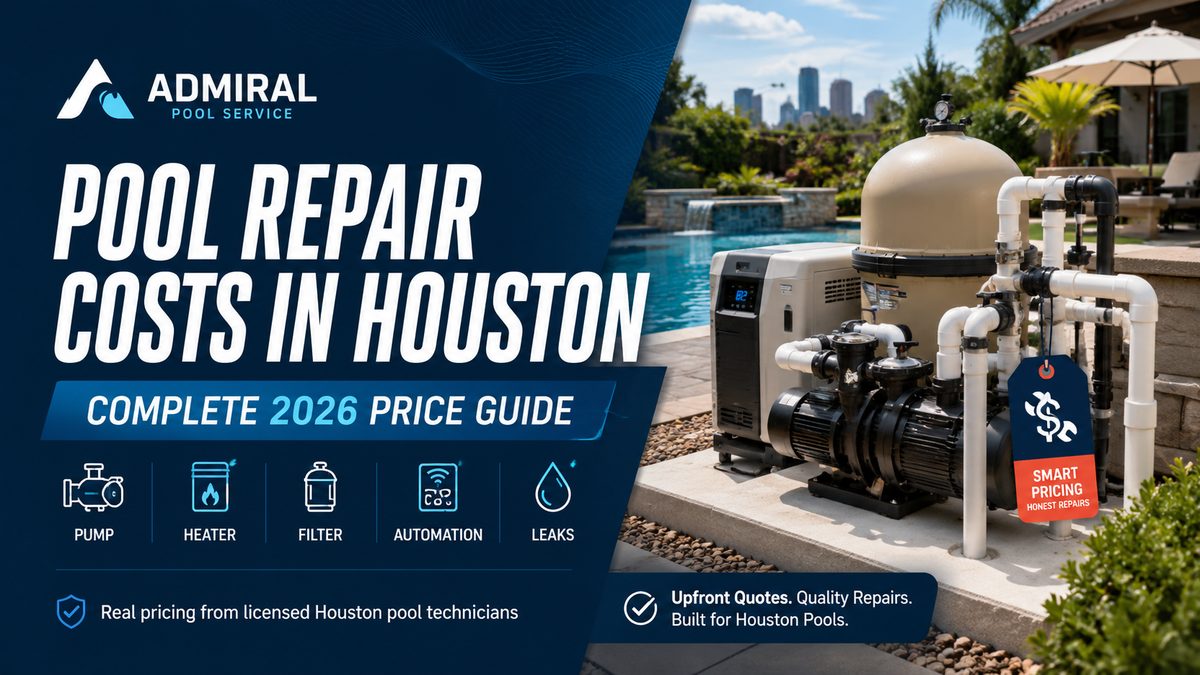
When pool equipment breaks down, the first question every homeowner asks is: "How much is this going to cost me?" It's a fair question — and one that most pool companies dodge with vague answers like "it depends" or "we'd need to take a look."
We're going to give you real numbers. These are the actual price ranges Houston-area homeowners can expect to pay for the most common pool repairs in 2026, based on thousands of service calls our licensed technicians have completed across the Friendswood, League City, Pearland, and Clear Lake areas.
Important context: Connecting pool equipment — pumps, heaters, lights, automation — is regulated electrical work in Texas, and it takes a state license. Admiral has three licensed technicians in-house. That matters because an unlicensed technician working on your equipment can void manufacturer warranties, create safety hazards, and end up costing you significantly more in the long run.
Pool Pump Repairs & Replacement
The pool pump is the heart of your circulation system. When it fails, everything else follows — cloudy water, algae growth, and chemical imbalances. Pump issues are the single most common repair call we receive.
Common Pump Repairs
Motor replacement: $350–$800 depending on horsepower and whether it's a single-speed or variable-speed motor. Variable-speed motors cost more upfront but can save $50–$80/month on electricity in Texas heat.
Shaft seal replacement: $150–$300. This is the most common pump leak repair. If you see water pooling at the base of your pump, this is usually the culprit.
Impeller replacement: $200–$400. Symptoms include reduced water flow, strange noises, or the pump struggling to prime.
Capacitor replacement: $100–$200. If your pump hums but won't start, this is often the fix.
Full Pump Replacement
Single-speed pump: $800–$1,400 installed. These are being phased out by Department of Energy regulations. If yours fails, upgrading to variable-speed often makes more sense.
Variable-speed pump: $1,400–$2,800 installed. Brands like Pentair IntelliFlo, Hayward Super Pump VS, and Jandy VS FloPro range widely in price. The energy savings in Houston's climate typically pay for the upgrade within 12–24 months.
When to replace vs. repair: If your pump is over 8 years old, the repair costs more than 50% of a replacement, or it's a single-speed pump — replacement is usually the smarter investment.
Pool Heater Repairs & Replacement
Houston's mild winters mean pool heaters get less abuse than in northern states, but they still fail — usually from corrosion, ignition problems, or heat exchanger issues caused by improper water chemistry.
Common Heater Repairs
Ignitor / pilot assembly: $200–$450. The most common heater repair. Symptoms include the heater clicking but not firing, or firing intermittently.
Thermostat replacement: $200–$400. If your heater won't reach temperature or overheats, this is often the cause.
Heat exchanger repair: $500–$1,200. This is the most expensive heater repair. Corrosion from low pH or high salt levels is the usual cause. Sometimes it's more cost-effective to replace the entire unit.
Pressure switch / flow sensor: $150–$300. These safety sensors prevent the heater from firing when water flow is insufficient.
Full Heater Replacement
Gas heater (250K–400K BTU): $2,500–$4,500 installed. Gas heaters heat fastest and work regardless of air temperature.
Heat pump: $3,500–$6,000 installed. More efficient than gas in Houston's climate since they extract heat from warm air. Lower operating costs but slower heating.
Average heater lifespan in Houston: 7–12 years with proper water chemistry management. Poor chemistry — especially low pH and high calcium — can cut that in half.
Need Professional Pool Help?
Admiral Pool Service has been keeping Greater Houston pools crystal clear since 2019. Licensed, insured, and PHTA certified.
Pool Filter Repairs & Replacement
Your filter removes debris and contaminants from the water. Houston's high pollen counts, dust, and organic debris from live oaks and pine trees put extra strain on pool filters compared to drier climates.
Common Filter Repairs
Cartridge replacement (cartridge filters): $150–$400 depending on the filter model and number of cartridges. Most cartridge filters need replacement every 1–2 years in Houston.
Multiport valve repair (sand/DE filters): $250–$500. Symptoms include water leaking from the backwash line or the filter not cleaning properly.
Pressure gauge replacement: $50–$100. A small part but critical for knowing when to clean your filter. If your gauge always reads zero or doesn't move, it needs replacing.
Lateral replacement (sand filters): $300–$600. If you're finding sand in your pool, a cracked lateral inside the filter is the likely cause.
Full Filter Replacement
Cartridge filter: $800–$1,800 installed. Most popular for residential Houston pools. Low maintenance and excellent filtration.
Sand filter: $900–$1,600 installed. Sand media should be replaced every 5–7 years ($300–$500 for a sand change).
DE (diatomaceous earth) filter: $1,200–$2,500 installed. Best filtration quality but more maintenance. Popular for pools with attached spas.
Salt System Repairs & Replacement
Salt chlorine generators are increasingly popular in Houston because they produce chlorine continuously and reduce the need for manual chemical additions. But they have their own set of repair issues.
Salt cell replacement: $400–$900. Salt cells typically last 3–5 years. Signs of failure include low chlorine production, error codes, or visible calcium buildup that won't clean off.
Control board replacement: $300–$700. If the system powers on but won't generate chlorine, or displays persistent error codes after cleaning the cell, the board may need replacement.
Flow sensor replacement: $100–$250. These sensors tell the system water is flowing before it generates chlorine.
Full salt system replacement: $1,500–$3,500 installed. Brands like Pentair IntelliChlor, Hayward AquaRite, and Jandy AquaPure vary in price and cell life.
Automation System Repairs
Pool automation systems (Pentair IntelliCenter, Hayward OmniLogic, Jandy iAqualink) let you control pumps, heaters, lights, and water features from your phone. When they malfunction, diagnosing the issue requires specialized training.
Relay replacement: $150–$350. Relays are the switches that turn equipment on and off. When a specific piece of equipment won't respond to the controller, a failed relay is often the cause.
Actuator replacement (valve motors): $200–$500. These motorized valves direct water flow between pool, spa, and water features.
Control panel replacement: $1,500–$4,000+. Major automation failures sometimes require replacing the entire control center. This is where having a licensed, factory-trained technician matters most.
Wireless module / antenna: $200–$400. If your phone app can't connect to your pool system, this is usually the fix.
Plumbing & Leak Repairs
Pool plumbing issues range from minor fitting leaks to major underground pipe repairs. Houston's clay soil and seasonal ground movement create unique plumbing challenges for pool owners.
Above-ground fitting/valve leak: $150–$350. Leaks at visible pipe connections, unions, or valves are the easiest and cheapest to fix.
Skimmer repair: $300–$600. Cracks in the skimmer body or separation from the pool wall require specialized repair.
Underground leak detection: $250–$500 for the diagnostic. Leak detection uses pressure testing and acoustic equipment to locate leaks without excavation.
Underground pipe repair: $500–$2,000+ depending on location, depth, and accessibility. This is one of the few pool repairs that can exceed $1,000 quickly.
Need Professional Pool Help?
Admiral Pool Service has been keeping Greater Houston pools crystal clear since 2019. Licensed, insured, and PHTA certified.
What Affects Pool Repair Costs in Houston?
Several factors specific to the Houston market influence what you'll pay for pool repairs:
Equipment brand and age: Pentair, Hayward, and Jandy parts vary significantly in price. Older equipment (10+ years) may require discontinued parts that cost more to source or fabricate.
Licensing and insurance: Licensed technicians charge more per hour than unlicensed operators — but they're the only ones legally authorized to work on gas heaters, electrical connections, and plumbing modifications. Hiring unlicensed labor can void warranties and create liability issues.
Emergency vs. scheduled: Weekend and emergency calls typically carry a premium. Scheduling repairs in advance saves money and allows the technician to arrive with the right parts.
Houston climate factors: The combination of extreme heat, high humidity, frequent storms, and heavy pollen means pool equipment works harder in Houston than in most markets. This leads to faster wear and more frequent repairs, but also means technicians here develop deep expertise in heat-related failures.
Water chemistry history: Pools with a history of poor chemistry — high calcium, low pH, or excessive CYA — experience equipment failures at 2–3x the normal rate. Proper weekly service isn't just about clean water; it protects your equipment investment.
Repair vs. Replace: How to Decide
This is the most common question homeowners ask, and there's a simple framework we use:
Replace if the equipment is past 70–80% of its expected lifespan, the repair cost exceeds 50% of replacement cost, the equipment uses obsolete technology (single-speed pumps, analog controllers), or you've had more than two repairs in the past 12 months.
Repair if the equipment is relatively new (under 5 years), the repair is under $500, the failure is a common wear item (seal, capacitor, cartridge), or the equipment is otherwise performing well.
A licensed technician should always present both options with honest cost comparisons. If a company only pushes replacement, they may be optimizing for their revenue, not your best interest.
How to Avoid Expensive Pool Repairs
The most expensive repair is the one that could have been prevented. Here's what consistently saves Houston homeowners money:
Consistent water chemistry management: Balanced pH, alkalinity, and calcium hardness protect every piece of equipment in your system. This is the single biggest factor in equipment longevity.
Regular filter maintenance: A clean filter reduces strain on your pump and prevents secondary failures. In Houston's high-debris environment, this matters more than in most markets.
Professional weekly service: Having a trained technician inspect your equipment weekly catches small problems before they become expensive emergencies. A loose fitting today is a $150 repair. That same fitting ignored for three months becomes a $1,500 plumbing job.
Storm preparation: Houston's hurricane season and severe thunderstorms can damage equipment. Turning off breakers before major storms and scheduling post-storm inspections protects your investment.
Getting a Repair Quote from Admiral
When you contact Admiral for a repair, here's what to expect: We dispatch a licensed technician to diagnose the issue — not a salesperson. We provide a written quote with the repair cost and, when applicable, a replacement option for comparison. We explain what failed, why it failed, and how to prevent it from happening again. And we stock the most common parts on our service vehicles so many repairs can be completed the same day.
Our repair technicians hold RAI licenses from the State of Texas and carry manufacturer certifications from Pentair, Hayward, and Jandy. That means your warranty stays intact, the work meets code, and you're not gambling on an unlicensed operator.
Need Professional Pool Help?
Admiral Pool Service has been keeping Greater Houston pools crystal clear since 2019. Licensed, insured, and PHTA certified.
Free Download
Houston Pool Chemistry Cheat Sheet
Ideal ranges, troubleshooting fixes, seasonal tips, and pump runtimes — all on one page. Built specifically for Houston pools.
No spam. Just pool tips from real technicians.