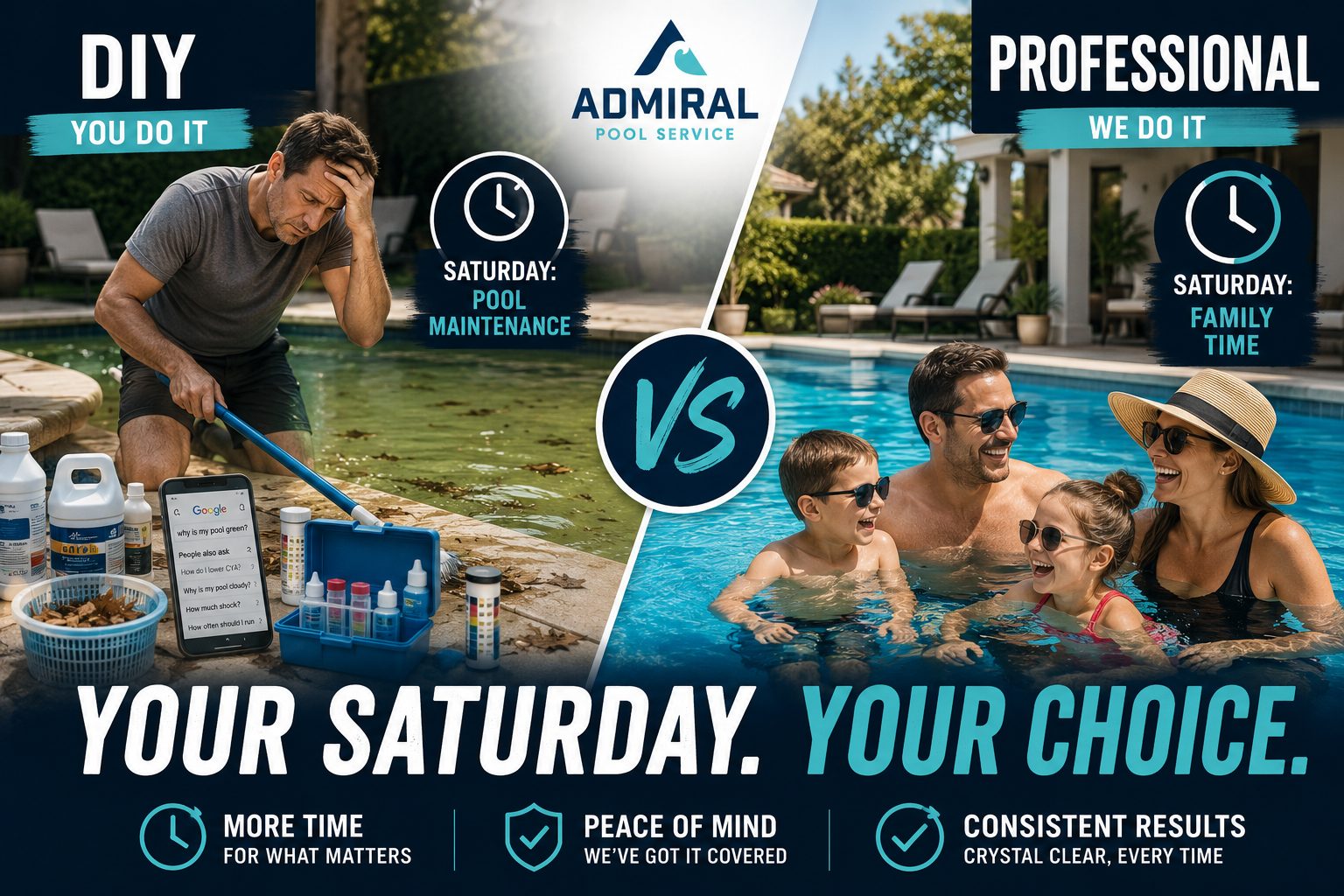
Every Saturday morning in Houston, thousands of pool owners face the same choice: spend the next two hours skimming, testing, and balancing, or hand it off and spend that time in the water with their kids. Same pool, same Saturday, two very different mornings.
This isn't a sales pitch for professional service. It's the honest math on what each option costs in time, money, knowledge, and risk — from a Friendswood company that services 900+ pools every week and still tells some homeowners they should keep doing it themselves.
The Real Time Commitment of DIY Pool Care
Most "how long does pool maintenance take" articles say 30 minutes a week. That number is misleading because it only counts the physical task of skimming and adding chemicals — not everything else that goes into keeping a pool healthy.
Here's what a realistic weekly DIY schedule looks like in Houston:
Skimming, brushing, and vacuuming: 30–45 minutes. Houston's live oaks, pine needles, and seasonal pollen mean your pool collects significantly more debris than pools in drier climates.
Water testing and chemical adjustment: 15–30 minutes. This includes testing for free chlorine, combined chlorine, pH, alkalinity, CYA, and calcium hardness. Test strips give approximate readings; accurate management requires a proper reagent kit.
Filter inspection and cleaning: 15–30 minutes every 1–2 weeks. Cartridge filters need regular hosing; sand and DE filters need backwashing.
Equipment check: 10–15 minutes. Checking pump baskets, inspecting for leaks, listening for unusual sounds, verifying pressure readings.
Supply runs: 20–40 minutes per trip for chemicals, test reagents, and replacement parts. Most homeowners make 2–3 trips per month during peak season.
Research and troubleshooting: Variable — but when something goes wrong (and it will), expect to spend 1–3 hours diagnosing the issue and figuring out the fix.
Realistic weekly total: 2–4 hours per week. Over a year, that's 100–200 hours — the equivalent of 25 to 50 Saturday mornings. Put a dollar value on your weekend hours and the "free" option stops looking free.
The Real Cost Comparison
DIY pool care seems cheaper until you factor in everything you actually spend. Here's the honest math for a typical Houston residential pool:
DIY Annual Costs
Chemicals (chlorine, acid, stabilizer, algaecide, shock): $800–$1,500/year. Houston's heat and UV intensity burn through chlorine faster than northern markets. CYA management alone can cost $100–$200/year.
Test kits and reagents: $60–$150/year. Good reagent kits (Taylor K-2006) need refilling 2–3x per year.
Replacement parts and supplies: $100–$300/year. O-rings, filter cartridges, baskets, hose attachments — the small stuff adds up.
Equipment (initial): $200–$500 for a quality pole, net, brush, vacuum head, and test kit.
Mistakes and corrections: $200–$800/year. Over-stabilized water requiring partial drains ($200–$400), algae blooms from missed treatments ($100–$300 in shock chemicals), or equipment damage from chemistry errors.
Your time: 100–200 hours/year at whatever your hourly value is.
Total DIY cost: $1,400–$3,200/year + your time
Professional Service Annual Costs
Weekly service: $215–$300/month ($2,580–$3,600/year) for comprehensive weekly maintenance. This includes all chemicals, water testing, equipment inspection, skimming, brushing, and filter maintenance.
Your time: Near zero. You spend your weekends actually using the pool instead of maintaining it.
Total professional cost: $2,580–$3,600/year + free weekends
The gap is much smaller than most people expect — typically $1,000–$1,500/year. And that's before you factor in the value of your time, the cost of DIY mistakes, and the hidden cost most homeowners miss entirely: equipment damage from inconsistent chemistry.
Need Professional Pool Help?
Admiral Pool Service has been keeping Greater Houston pools crystal clear since 2019. Licensed, insured, and PHTA certified.
The Knowledge Gap Most Homeowners Underestimate
Pool water chemistry isn't as simple as "add chlorine." It's an interconnected system where every parameter affects every other parameter. Here's what professional technicians manage that most DIY pool owners struggle with:
The CYA problem: Cyanuric acid (stabilizer) protects chlorine from UV degradation — but too much CYA renders chlorine ineffective. In Houston, where UV intensity is extreme, CYA management is the number one chemistry challenge. Most DIY pool owners don't test for it regularly and end up with CYA levels above 100 ppm, which means their chlorine is doing almost nothing. The only fix is a partial drain and refill — a costly mistake that professionals prevent through weekly monitoring.
The pH and alkalinity relationship: pH affects chlorine's killing power. At pH 7.2, chlorine is about 65% effective. At pH 8.0, it drops to about 20%. Houston's high heat causes CO2 to off-gas from pool water, which drives pH up constantly. Understanding buffering capacity (alkalinity) and its relationship to pH drift is chemistry that takes months to learn properly.
Calcium hardness in Houston water: Houston's tap water already carries moderate to high calcium levels. Over time, calcium accumulates in pool water and can't be removed except by draining. Too high, and you get scale on your equipment and tile. Too low, and the water becomes corrosive and attacks your plaster, heater, and metal fittings.
Phosphate and nitrate management: These nutrients fuel algae growth. They enter your pool from fertilizer runoff, decomposing organic matter, and Houston's municipal water supply. Most test strips don't even measure them.
The point isn't that you can't learn this — you absolutely can. The question is whether you want to invest the time and make the inevitable mistakes along the way, or pay a professional who already has the expertise.
Equipment Knowledge: The Hidden Advantage of Professional Service
Your pool has a pump, filter, heater, salt system, automation controller, and potentially a booster pump, water feature, or spa jets. Each piece of equipment has its own maintenance requirements, failure modes, and warning signs.
Professional technicians inspect this equipment every week. They know what a healthy pump sounds like versus one with a failing bearing. They notice the pressure gauge creeping up before your filter clogs completely. They spot the small leak at a fitting before it becomes a major plumbing failure.
This is where professional service delivers the most value — not in the cleaning, but in the early detection of equipment problems. A $150 repair caught early can prevent a $2,000 emergency replacement. Our licensed technicians see patterns across hundreds of pools and can predict failures before they happen.
The Houston-Specific Challenges
Pool maintenance in Houston is meaningfully harder than in most other markets. Here's why:
Extreme heat (May–September): Water temperatures above 85°F accelerate algae growth, increase chlorine demand by 2–3x, and put additional stress on equipment. Most DIY guides are written for moderate climates and underestimate chemical requirements for Houston's heat.
High humidity: Reduces evaporative cooling, keeping water warmer longer. Also contributes to corrosion on exposed metal fittings and equipment enclosures.
Pollen season (February–May): Houston's pollen counts routinely exceed 1,000 grains/m³. This organic load overwhelms filters and creates phosphate spikes that fuel algae. Pools need 2–3x normal filter attention during pollen season.
Hurricane season (June–November): Severe storms dump debris, rainwater (which dilutes chemistry), and contamination into pools. Post-storm recovery requires specific protocols for shocking, re-balancing, and equipment inspection.
Year-round maintenance: Unlike northern pools that close for winter, Texas pools require 12-month service. There's no off-season where you can take a break from maintenance.
When DIY Makes Sense
We'll be honest — professional service isn't the right choice for everyone. DIY pool maintenance can work well if you genuinely enjoy the process and treat it as a hobby, you have a chemistry or engineering background, your pool is simple (no heater, no salt system, no automation), you're home most of the time and can maintain a consistent schedule, and you're committed to proper testing with reagent kits, not just strips.
If those describe you, DIY can be a rewarding way to understand your pool. Just invest in proper education — a CPO (Certified Pool Operator) class costs about $300 and will teach you more in two days than months of YouTube research.
When Professional Service Is the Better Investment
Professional service makes the most sense for homeowners who value their weekends more than saving $100/month, have complex equipment (heaters, salt systems, automation), travel frequently or have an irregular schedule, have experienced recurring chemistry problems or algae blooms, own a pool with a plaster or pebble finish that's sensitive to chemistry imbalances, or simply want the peace of mind that comes from knowing a licensed technician inspects everything weekly.
The most common conversion story we hear is this: a homeowner spends 1–2 years doing DIY maintenance, has a major chemistry problem or equipment failure that costs $500–$2,000 to fix, and then signs up for professional service. They almost always say the same thing — "I wish I'd started with professional service from the beginning."
What to Look for in a Professional Pool Service
If you decide professional service is right for you, here's how to evaluate companies:
Verify licensing: Connecting a pump, heater, or automation system is regulated electrical work in Texas, and it takes a state license. Ask for their RAIC license number and verify it with the state. Admiral has three licensed technicians in-house.
Ask about chemical service vs. skimmer service: Some budget companies only skim the surface and add chlorine. Comprehensive service includes full water testing, chemistry balancing, filter maintenance, and equipment inspection. Know what you're paying for.
Look for dedicated technicians: The best companies assign the same technician to your pool every week — a trained W-2 employee, not a rotating subcontractor. Your tech should know your pool, your equipment, and what it looked like last Tuesday.
Check for certifications: CPO (Certified Pool Operator), PHTA certifications, and manufacturer training (Pentair, Hayward, Jandy) indicate a company that invests in their team's expertise.
Read reviews for consistency: A few five-star reviews mean nothing. Look for consistent, specific praise across dozens or hundreds of reviews. Admiral maintains a 4.9-star rating across 390+ reviews from Houston homeowners.
The Bottom Line
DIY pool maintenance costs $1,400–$3,200/year plus 100–200 hours of your time. Professional service costs $2,580–$3,600/year with that time handed back to you. The financial gap is smaller than most homeowners assume, and one over-stabilized pool or missed algae bloom usually closes it completely.
So the real question was never "can I maintain my pool myself?" Most people can. It's "is that the best use of my Saturday?" Your Saturday. Your choice. If you'd rather spend it in the pool than behind it, that's exactly what we're here for.
Need Professional Pool Help?
Admiral Pool Service has been keeping Greater Houston pools crystal clear since 2019. Licensed, insured, and PHTA certified.
Free Download
Houston Pool Chemistry Cheat Sheet
Ideal ranges, troubleshooting fixes, seasonal tips, and pump runtimes — all on one page. Built specifically for Houston pools.
No spam. Just pool tips from real technicians.